
Aesthetic Dentistry and Smile Design

The Single and Reliable Choice for Your Health

Aesthetic Dentistry and Smile Design
Smile Design
Smile design is a compheresive planning process that aims to create a harmonious smile by evaluating the color and shape of the teeth as well as the lip structure, gum line, facial symmetry, jaw relationship and the patient’s aesthetic expectations. Digital impressions are taken along with facial and intraoral photographs; a personalized design is created by evaluating the golden ratio, lip line midline and tooth dimensions. Treatments such as whitening, composite or porcelain veneers (laminates), gum contouring, orthodontics and implants can be planned based on decay, wear, discoloration missing teeth and alignment disorders. The expected result is demonstrated through a wax-up or digital simulation. The processs considers chewing, speech and oral health alongside aesthetic appearance.

Aesthetic Dentistry and Smile Design
Computer-Aided Dental Design
Computer-aided dental desgin is a modern approach that increases precision and predictability by integrating digital technology into traditional smile design, allowing the patient to see the targeted result in three dimension before treatment. Facial and intraoral photographs are analyzed in special software to digitally create tooth dimensions, shape and alignment suitable for facial symmetry, lip movements and smile line. Different design options can be compared and the patient and dentist can decide together. Design data can be transferred to CAD/CAM systems to produce laminate veneers, crowns and other restorations with high precision. In some cases, the design can be tested in the mouth with a temporary mock-up. Digital data can also be saved as a reference for future adjustments.
Aesthetic Dentistry and Smile Design
Aesthetic Dentistry Applications
Aesthetic dentistry applications encompass a broad range of treatments aimed at improving the appearance of teeth and the smile while preserving or enhancing natural function. Procedures such as teeth whitening, composite bonding, porcelain laminate veneers, gum contouring, and smile design can be planned individually or in combination. Changes in tooth color, crooked or spaced teeth, broken and worn surfaces, missing teeth, an asymmetrical gum line, and dissatisfaction with one’s smile are the main reasons for seeking treatment. Before treatment, oral health, the patient’s expectations, budget, and time schedule are evaluated. While modern porcelains and composites offer a natural appearance and durability, regular post-treatment care helps maintain aesthetic results over the long term.
Aesthetic Dentistry and Smile Design
Laminate Veneer (Porcelain Veneers)
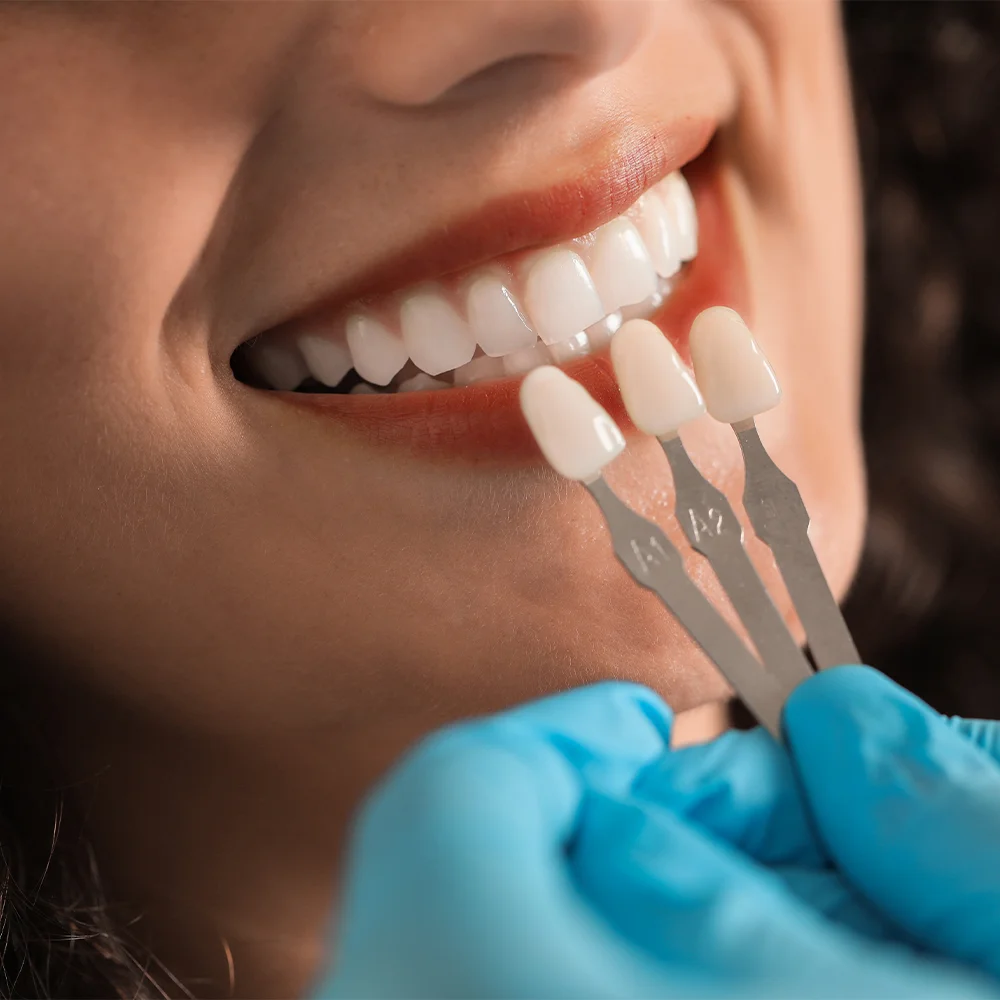
Laminate veneers, commonly known as porcelain veneers, are thin porcelain restorations, generally 0.5–1 mm thick, applied to the front surfaces of teeth. They are preferred for permanent discoloration, teeth that do not respond to whitening, and teeth that are cracked, worn, spaced, or slightly crooked. The treatment begins with an evaluation of the tooth structure and expectations, followed by determining the desired result through digital smile design or a wax-up. Approximately 0.5 mm of tooth enamel is removed to prepare the surface, which is then used to take an impression, and custom-made laminates are produced. The permanent laminates are bonded using a special adhesive resin. Offering a natural appearance and stain resistance, laminates can last 10–15 years or longer with proper care. If teeth clenching or grinding is present, a night guard may be recommended.
Aesthetic Dentistry and Smile Design
Lamina Applications
Lamina applications involve placing thin veneers on tooth surfaces to aesthetically improve their shape, color, size, or alignment, and are divided into two main categories: porcelain laminate veneers and composite laminates. The choice is made according to aesthetic goals, budget, the current condition of the tooth, and treatment duration. While porcelain laminates are more durable and offer greater color stability, composite laminates provide a faster and more economical option by being applied in a single session. The amount of tooth reduction is determined by evaluating the tooth structure and enamel thickness; no-prep or minimal-prep techniques may be applied in suitable cases. The result can be evaluated in advance using a wax-up, digital simulation, or trial veneers. Regular care, professional check-ups, avoiding hard objects, and using a night guard in cases of teeth clenching support long-term durability.
Aesthetic Dentistry and Smile Design
Composite Veneer / Direct and Indirect Composite Laminate
Composite veneer is a type of laminate in which a tooth-colored resin-based material is applied to the tooth surface to provide aesthetic improvement in terms of shape, color, and size. Direct composite laminate is performed by applying the material in layers inside the mouth in a single session and hardening it with light, while the indirect method involves taking an impression, having the veneer fabricated in a laboratory, and bonding it to the tooth. The indirect method offers greater durability, surface smoothness, and longevity. Composite veneers may require less or no tooth reduction compared to porcelain, are more economical, and can be easily repaired when necessary. However, their color stability is lower than that of porcelain; coffee, tea, and smoking may cause discoloration over time. Regular polishing and check-ups help maintain their appearance.
Aesthetic Dentistry and Smile Design
Teeth Whitening
Teeth whitening is a minimally invasive aesthetic treatment in which the color of teeth is lightened using gels containing hydrogen peroxide or carbamide peroxide to address discoloration caused by coffee, tea, red wine, smoking, aging, or certain medications. In-office whitening is performed at the clinic using a high-concentration gel and takes approximately 30–60 minutes, while the at-home method involves using a low-concentration gel with custom-made trays, generally for 2–3 weeks. Since whitening is effective only on natural teeth, the color of fillings and crowns does not change. Temporary sensitivity may occur and usually subsides within a few days. Avoiding foods and beverages that cause staining for 24–48 hours after treatment is recommended. The results can be maintained for 6 months–2 years and the treatment can be repeated when necessary. It is recommended to postpone treatment during pregnancy and breastfeeding.
Aesthetic Dentistry and Smile Design
E-Max Dental Crowns
E-max dental crowns are metal-free glass ceramics made from lithium disilicate, offering high aesthetics thanks to their light translucency, which resembles natural tooth enamel. They are particularly preferred for front teeth and prevent the formation of the gray line along the gum margin that can be seen with metal-supported crowns. They can be used for single crowns, short-span bridges, laminate veneers, and implant-supported crowns. They are designed using CAD/CAM technology based on digital or conventional impressions and manufactured in special furnaces. Compared to traditional metal-supported crowns, they may require less tooth reduction. The treatment is generally completed in two appointments; during the first, the tooth is prepared and an impression is taken, while the permanent crown is placed at the second appointment. With proper care, they can be used for 15 years or longer. A night guard is recommended in cases of excessive teeth clenching.
Aesthetic Dentistry and Smile Design
Aesthetic Porcelain
Aesthetic porcelain restorations include crowns, bridges, laminate veneers, and inlays-onlays made from ceramics that mimic the optical properties of natural tooth enamel. Thanks to their ability to reflect and transmit light in a way similar to natural enamel, they provide a natural appearance, particularly for front teeth. They can be used for anything from a single missing tooth to comprehensive oral rehabilitations; the type of porcelain is determined according to the tooth’s position, chewing forces, and aesthetic expectations. Available options include feldspathic porcelain, lithium disilicate (E-max), and zirconia porcelain. During production, a digital scan or impression is taken, and a layered structure is created to match the tooth color and adjacent teeth. They are resistant to discoloration, staining, and wear. They can be used for many years with regular care and check-ups; marginal fit and oral hygiene are important for long-term success.
Aesthetic Dentistry and Smile Design
Zirconia Porcelain Crowns / Zirconia Restorations
Zirconia porcelain crowns are restorations prepared by applying porcelain over a zirconium dioxide framework, offering high mechanical strength and aesthetics. While full zirconia crowns are made entirely of zirconia and are particularly preferred for posterior teeth and areas exposed to high chewing forces, layered zirconia crowns are used especially for front teeth to provide superior aesthetics. Zirconia is digitally designed and milled using CAD/CAM technology, then sintered at high temperatures to achieve its final hardness. Due to its biocompatibility and metal-free composition, it is compatible with the gums; the gray line that can occur with metal-supported crowns does not form. It can also be used in implant-supported restorations. The treatment is generally completed in two appointments and, with proper care, can last for more than 15 years.